DMARC vendors in 2026: pricing, EU data residency, SSO
Shortlist of DMARC vendors compared on 2026 pricing (GBP/AUD/EUR), EU/UK data residency, SSO/SAML and audit logs. dmarcian, EasyDMARC, Valimail, DMARCTrust.

You need DMARC monitoring. Google and Yahoo tightened bulk sender requirements in February 2024, and DMARC is now table stakes for deliverability and brand protection. Your security team wants visibility. Your compliance officer needs audit trails. Your finance team wants a published price in their currency before raising a PO.
But which vendor? There are dozens of DMARC tools, and they all claim to do the same thing. Some cost $20/month. Others want enterprise contracts.
Last updated: June 9, 2026.
Disclosure: DMARCTrust is our product. This article is written to be useful even if you choose another tool.
Methodology: We compare vendors using publicly available information (pricing pages, documentation, security and compliance pages) and typical buyer evaluation criteria. Vendors change pricing and features frequently, so treat the tables as a starting point and verify details on each vendor’s site and contract.
A shortlist of 5 DMARC vendors to evaluate
For a UK or EU buyer looking to shortlist quickly, these five vendors cover the range from self-serve SMB to enterprise-managed:
- DMARCTrust: self-serve monitoring with a free tier and native GBP/AUD/EUR prices from £13.90/month (Starter). EU or US data region chosen at signup. No SAML today; SOC 2 in progress.
- dmarcian: founded by one of the primary authors of the DMARC spec, SOC 2 Type II certified, multiple regional data centers. SSO is gated to the Enterprise tier. Prices in USD from $24/month.
- EasyDMARC: EU-headquartered and billed in EUR (from €35.99/month billed annually), SOC 3 report published, SSO at Enterprise tier. Strong candidate for European buyers who want a vendor billing in their currency.
- PowerDMARC: SSO, SAML 2.0, and OIDC available across plans (Azure AD, Okta, Google, OneLogin, JumpCloud), ISO 27001:2022 certified, free tier available. Entry pricing from around $8/month; verify current pricing at powerdmarc.com.
- Valimail: managed enforcement at enterprise scale, SOC 2 Type 2, FedRAMP deployment option for federal environments. SAML/SSO on the Enterprise tier. Paid enforcement from $5,000/year; free Monitor tier available.
For a longer ranked comparison, see Best DMARC monitoring service in 2026: 6 tools compared.
Master comparison table (verified June 2026)
Prices are per month on monthly billing unless noted. Verify on each vendor’s pricing page before committing.
| Vendor | Entry paid price | Domains included | EU/UK data residency | SSO/SAML (tier) | Audit logs | SOC 2 |
|---|---|---|---|---|---|---|
| DMARCTrust | $19 / £13.90 / €18 / A$29 | 2 | EU or US, chosen at signup | Google sign-in only (no SAML) | Yes | In progress |
| dmarcian | $24/mo (USD) | 2 | Multiple regions, user choice | Enterprise tier only | Yes | Type II |
| EasyDMARC | €35.99/mo (billed annually) | 2 | EU-headquartered | Enterprise tier only | Yes | SOC 3 published |
| PowerDMARC | ~$8/mo (verify at powerdmarc.com) | Check site | Not stated as dedicated EU region | SSO/SAML/OIDC available broadly | Yes | ISO 27001:2022 |
| Valimail | $5,000/yr (Enforce Starter) | Not stated | Enterprise configuration | Enterprise tier only | Yes | Type 2 |
| DMARCLY | $17.99/mo (USD) | Not stated | US or EU region choice | Not stated | Not stated | Not stated |
Notes. “EU data residency” and “GDPR-compliant” are different claims. GDPR compliance (a DPA, sub-processor list, Standard Contractual Clauses) is a legal framework. A dedicated EU data region means data is stored and processed in the EU, not transferred to US servers. Ask vendors which they are offering. Valimail data residency is typically scoped in enterprise procurement. PowerDMARC is AWS-hosted and GDPR-ready but does not advertise a dedicated EU region.
DMARCLY sits outside the shortlist of five but is included in the table because it is commonly evaluated for cost-sensitive multi-domain deployments. It publishes less compliance detail than the others; its head-to-head section is below.
What to look for in a DMARC vendor
Before comparing specific tools, establish your criteria. These are the factors that separate useful monitoring from expensive noise.
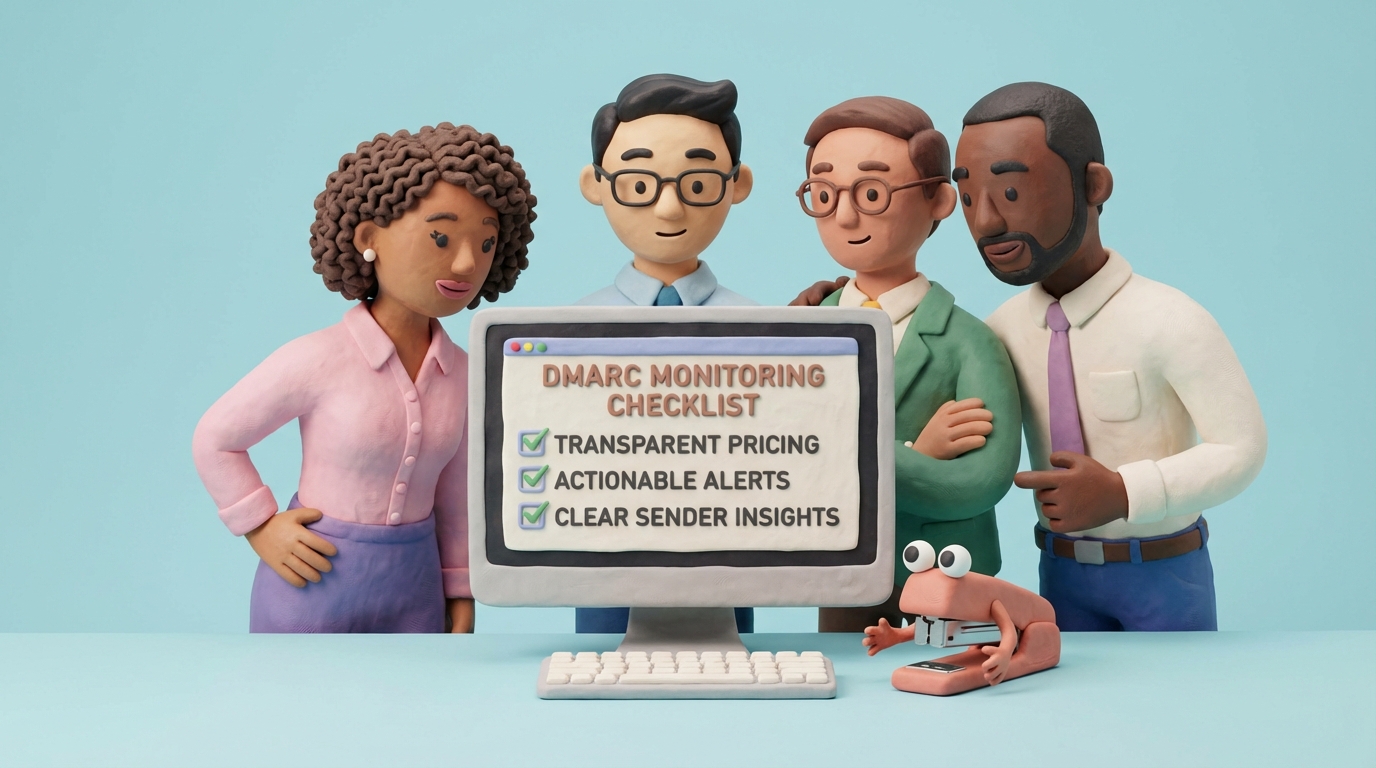
Transparent pricing
Can you see the price before talking to sales? This sounds basic, but many DMARC vendors hide pricing behind “contact us” forms. If you’re a small or mid-size business, you don’t need a sales call to monitor 5 domains.
Look for published pricing on the website, clear per-domain or volume-based tiers, no surprise fees for basic features, and a free tier or trial without credit card requirements.
Reporting quality (decode and normalization)
The core job of a DMARC monitoring tool is to reliably ingest aggregate reports (RUA), decode them, and present consistent results you can act on. Ask:
- How quickly do reports show up after setup?
- Do they deduplicate/reconcile reports from different providers?
- Can you label/identify senders in a way your team can maintain over time?
- Can you export your data if you ever switch tools?
Data residency options
Where does your DMARC data live? This matters more than you might think.
DMARC reports contain IP addresses of everyone sending email as your domain. Under GDPR, IP addresses can be considered personal data. If you’re a European company, you may need that data to stay in the EU.
Some vendors offer regional data centers. Others process everything in the US regardless of where you are. A few let you choose at signup.
Questions to ask:
- Can I choose my data region?
- Is EU-only storage available?
- Are there data transfer agreements for cross-border processing?
We wrote about why data residency matters when we added EU and US zones to DMARCTrust.
Multi-domain support
Most businesses have more than one domain: the main website, marketing subdomains, legacy domains, acquired company domains. DMARC monitoring should cover all of them without painful per-domain pricing.
Check:
- How many domains are included in each plan?
- What’s the cost per additional domain?
- Can you group domains for easier management?
- Are subdomains counted separately?
DNS change monitoring
Human error breaks DMARC. Someone updates an SPF record and exceeds the 10-lookup limit. A well-meaning IT admin removes a DKIM key. A DNS provider migration drops your DMARC record entirely.
Good DMARC tools catch these mistakes before they cause deliverability problems. Look for:
- Automatic DNS validation on a schedule
- Alerts when records change or break
- History of DNS changes over time
- Severity classification (critical vs informational)
This feature alone can save hours of debugging when email suddenly stops working.
Actionable alerts
Getting 50 emails per day about “DMARC activity” isn’t monitoring. It’s noise. You need alerts that tell you something is wrong and what to do about it.
Useful alerts include:
- Authentication failure spikes (not every single failure)
- DNS configuration changes
- New senders appearing in your reports
- Domains going silent (no reports for extended periods)
Ask whether you can configure alert thresholds and choose which alerts you receive.
Workflow and collaboration
DMARC work is cross-functional: security, IT, marketing ops, and sometimes external agencies. Evaluate:
- Roles/permissions and audit logs
- Notes/labels you can share internally
- API access and exports (for SIEM, reporting, or internal dashboards)
Clean interface
You’ll look at this dashboard regularly. If it takes 10 clicks to find your SPF pass rate, you won’t use it.
The best DMARC dashboards show:
- Overall compliance status at a glance
- Trends over time (is authentication improving?)
- Breakdown by sending source
- Clear paths to investigate failures
Screenshots on vendor websites tell you a lot. If the UI looks cluttered in their marketing materials, imagine using it daily.
GDPR and compliance
Beyond data residency, consider:
- Does the vendor offer a Data Processing Agreement (DPA)?
- Are they SOC 2 certified?
- Can they support your vendor security questionnaire?
- How long do they retain your data?
For European companies, GDPR compliance isn’t optional. Even US companies increasingly need these guarantees for enterprise customers.
Security features
Your DMARC dashboard contains sensitive information about your email infrastructure. Basic security expectations:
- Two-factor authentication (2FA) as standard
- Role-based access for teams
- Audit logs of account activity
- SSO integration for enterprise
If a vendor doesn’t offer 2FA in 2026, that’s a red flag about their security posture.
Pricing currency and billing
UK and Australian buyers frequently ask which DMARC tools publish prices in their local currency. As of June 2026:
- DMARCTrust publishes native prices in USD, GBP, EUR, CAD, and AUD with monthly billing. Starter is $19 / £13.90 / €18 / A$29 / C$26 per month. Pro is $49 / £35.90 / €42 / A$70 / C$67 per month. See DMARCTrust pricing.
- EasyDMARC bills in EUR. Plus plan is €44.99/month (€35.99 billed annually).
- dmarcian publishes prices in USD. Basic is $24/month ($239.88/year); Plus is $240/month; Enterprise is $600/month.
- PowerDMARC publishes prices in USD; entry around $8/month. Verify current pricing at powerdmarc.com.
- Valimail publishes Enforce Starter at $5,000/year in USD. Enterprise pricing is quote-based.
If native GBP or AUD billing matters for your purchase order or VAT reporting, that narrows the field to DMARCTrust. EasyDMARC is the natural fit for EUR buyers who prefer a vendor also headquartered in the EU.
SSO, SAML, and audit logs
This is one of the clearest differentiators in an enterprise evaluation. The picture as of June 2026:
- dmarcian: SSO available on Enterprise tier only ($600/month). Basic and Plus plans do not include SSO.
- EasyDMARC: SSO at Enterprise tier only. Self-serve plans use username/password with 2FA.
- PowerDMARC: SSO, SAML 2.0, and OIDC available across plans (Azure AD, Okta, Google Workspace, OneLogin, JumpCloud). This is broader than most competitors.
- Valimail: SAML/SSO on the Enterprise tier only. The free Monitor tier does not include it.
- DMARCTrust: Google sign-in (OAuth) only. No SAML or OIDC federation today. SOC 2 is in progress. Teams that require SAML for IdP provisioning should note this limitation plainly.
All five vendors provide audit logs of account activity. The depth and exportability vary; ask to see an example audit log export before signing a contract.
GDPR compliance vs. dedicated EU data region. These are not the same thing. A vendor can be fully GDPR-compliant (DPA, SCCs, sub-processor list) while storing and processing your data in the US. A dedicated EU data region means your data does not leave the EU, which is the stronger claim for organizations under strict data sovereignty requirements (financial services, healthcare, public sector). DMARCTrust offers a genuine region choice at signup. dmarcian offers multiple regional data centers. EasyDMARC is EU-headquartered. PowerDMARC does not advertise a dedicated EU region (AWS-hosted, GDPR-ready). Valimail handles this in enterprise procurement.
Vendor comparison
Let’s look at the main DMARC vendors and how they stack up.
Verify vendor details (official pages)
Because DMARC tools change pricing, limits, and compliance posture over time, verify details directly on each vendor’s site before making a decision:
- DMARCTrust (dmarctrust.com): pricing, product, security/compliance
- Valimail (valimail.com): enterprise offering and procurement details
- dmarcian (dmarcian.com): product, pricing, compliance/security documentation
- EasyDMARC (easydmarc.com): pricing, compliance
- PowerDMARC (powerdmarc.com): pricing, SSO/SAML documentation
dmarcian pricing in 2026
dmarcian publishes four tiers (prices verified June 2026 from dmarcian.com/pricing):
| Plan | Monthly price | Domains | Message limit |
|---|---|---|---|
| Personal | Free | 2 (non-business use) | Low |
| Basic | $24/mo ($239.88/yr) | 2 | 100K/month |
| Plus | $240/mo | 8 | 1M/month |
| Enterprise | $600/mo | 15 | 5M/month |
SSO is available on Enterprise only. All paid tiers include SOC 2 Type II vendor attestation. Annual billing saves roughly one month’s cost.
DNS change monitoring
| Vendor | Automatic checks | Change alerts | History/timeline |
|---|---|---|---|
| DMARCTrust | Hourly | Yes, with severity | Yes |
| dmarcian | Yes | Yes | Limited |
| EasyDMARC | Yes | Yes | Yes |
| PowerDMARC | Yes | Yes | Yes |
| Valimail | Yes (automated) | Yes | Yes |
DMARCTrust checks monitored domains hourly on paid plans, requires the change to still be present on the following check before it alerts, and classifies each confirmed change by severity. See DMARC monitoring for how continuous DNS monitoring works in practice.
Multi-domain pricing
| Vendor | Extra domain cost | Volume limits |
|---|---|---|
| DMARCTrust | $12/£9/€10/A$18 per domain/month | No message limits |
| dmarcian | Tiered by plan | 100K to 5M messages/month |
| EasyDMARC | Tiered by plan | Check easydmarc.com |
| PowerDMARC | Tiered by plan | Check powerdmarc.com |
| Valimail | Enterprise pricing | Not published |
DMARCTrust does not charge based on email volume, only on domains. This is simpler for high-volume senders. dmarcian charges by message volume above plan limits, which can matter for large senders. DMARCLY ($1/domain over quota) is attractive if you have many low-activity domains.
Interface and usability
This is subjective, but it affects whether teams actually use the tool.
DMARCTrust has a focused dashboard where source insights show per-sender breakdown. See DMARC software for a feature overview.
dmarcian was founded by DMARC specification authors and the interface reflects that technical depth. Some users find the UI dated. See the dmarcian alternative comparison for a side-by-side.
EasyDMARC is well-regarded for its onboarding and guided enforcement workflow. See the EasyDMARC alternative comparison.
PowerDMARC covers DMARC, SPF, DKIM, BIMI, MTA-STS, and TLS-RPT in a single navigation. Dense but thorough. See our PowerDMARC alternative comparison.
Valimail targets organizations that want to move to p=reject with minimal manual configuration, and the interface is built around that workflow rather than raw report browsing.
Quick head-to-head comparisons
DMARCTrust vs dmarcian
Both are popular for teams that want clear reporting and a credible path to enforcement. If per-domain pricing, native GBP/AUD/EUR billing, and an explicit EU/US region choice at signup are priorities, DMARCTrust tends to be the simpler fit. If you need broader regional hosting options, SOC 2 attestation from the vendor, or SSO on a paid tier, dmarcian is a strong alternative. See the dmarcian alternative comparison for more detail.
DMARCTrust vs DMARCLY
If you’re comparing mainly on budget and have many low-activity domains, DMARCLY is often shortlisted. DMARCTrust suits teams that prefer pricing without message/report limits and want fast DNS checks with severity-based alerts.
DMARCTrust vs Valimail
This is usually a self-serve vs enterprise-managed decision. Valimail is commonly evaluated by teams that want a managed enforcement program with larger org workflows and integrations. DMARCTrust is built for teams that want quick setup, published pricing, and hands-on control. See the Valimail alternative comparison.
dmarcian vs Valimail
These two sit in different procurement categories. dmarcian is a self-serve analytics platform with per-domain pricing. Valimail is enterprise-managed with sales-led onboarding aimed at Microsoft 365/Salesforce/federal environments. If you want data-driven monitoring you can set up yourself, dmarcian is often simpler. If you need someone else to operate enforcement end-to-end across a large org, Valimail is the usual pick. Our Valimail alternative comparison goes deeper.
PowerDMARC vs Valimail: dashboard UI comparison
PowerDMARC and Valimail approach the UI quite differently. PowerDMARC’s dashboard is denser, with tabs for DMARC, SPF, DKIM, BIMI, MTA-STS, and TLS-RPT all in the same navigation. Valimail’s interface is more guided, built around moving to p=reject rather than browsing raw reports. If you want a quieter, report-first UI with source auto-resolution, our PowerDMARC alternative comparison walks through what DMARCTrust does differently.
Valimail alternatives: which DMARC solution is strongest?
The answer depends on what you are optimizing for. If hands-off enforcement automation for a large org is the priority, Valimail’s managed offering is hard to match. For cost, transparency, and analyst-grade source resolution without a sales procurement cycle, strong alternatives include DMARCTrust, dmarcian, EasyDMARC, and PowerDMARC. The head-to-heads above and our Valimail alternative comparison compare these on pricing, data residency, DNS monitoring, and UI workflow.
Enterprise note: Valimail and dmarcian
For large organizations with enterprise procurement requirements, Valimail and dmarcian are typically the frontrunners. Valimail offers FedRAMP deployment options for federal environments, SOC 2 Type 2, managed enforcement services, and integrations with Microsoft 365, Salesforce, and enterprise IAM. dmarcian brings SOC 2 Type II, a track record going back to 2012, multi-region data centers, and deep DMARC technical documentation.
DMARCTrust is a self-serve mid-market tool: fast to start, transparent pricing in local currencies, and hands-on control. It is not a managed service and does not currently offer SAML federation. Teams with strict IAM provisioning requirements or a need for a fully managed enforcement program should evaluate Valimail or dmarcian instead and use the scorecard below to compare.
When to choose each vendor
Choose DMARCTrust if you want:
- A free tier to evaluate with one domain, no credit card
- Transparent pricing without sales calls, in GBP/EUR/AUD/CAD
- Explicit data residency choice (EU or US)
- DNS change monitoring with severity classification
- Simple per-domain pricing without volume limits
- A focused tool that doesn’t overwhelm with features
We built DMARCTrust because we wanted DMARC monitoring that’s easy to start and easy to understand. Check your domain’s current status with our free DMARC checker.
Considerations / may not fit if:
- You require SAML/SSO enterprise IAM federation
- You want fully managed enforcement services instead of self-serve monitoring
- You need SOC 2 vendor attestation now (in progress, not yet certified)
Choose Valimail if you want:
- Enterprise-scale automation
- Managed DMARC enforcement services
- Integration with Microsoft, Salesforce, and enterprise IAM
- Compliance with federal security standards (FedRAMP)
- A vendor that handles most configuration for you
Valimail offers a free DMARC monitoring tier (Valimail Monitor), which is a common starting point, especially for Microsoft 365 environments. Paid enforcement starts at $5,000/year.
Considerations / may not fit if:
- You only need monitoring for a handful of domains and want instant self-serve signup
- You strongly prefer fully published pricing with no procurement cycle
Choose dmarcian if you want:
- Deep technical credibility (founded by one of the primary DMARC spec authors)
- Multiple regional data centers worldwide
- SOC 2 Type II certification for enterprise procurement
- Educational resources and DMARC expertise
- A well-established vendor with long track record since 2012
Considerations / may not fit if:
- You prefer the newest UI/UX over a feature-rich, established interface
- Your cost model is “many domains, very low volume” (plan message limits apply)
Choose EasyDMARC if you want:
- A vendor headquartered and billing in EUR
- SOC 3 published compliance report
- Modern onboarding with guided enforcement workflow
- Entry pricing from €35.99/month (billed annually, 2 domains)
Considerations / may not fit if:
- You need SAML/SSO on a self-serve plan (Enterprise only)
- You want USD or GBP as your billing currency
Choose DMARCLY if you want:
- Low entry price ($17.99/month)
- DNS timeline feature
- Ability to import reports from other vendors
- Cost-effective scaling for many domains ($1/domain over quota)
DMARCLY offers good value, especially if you’re migrating from another tool and want to bring historical data.
Considerations / may not fit if:
- Your program is high-volume and you want pricing that doesn’t vary with message/report limits
- You need a lighter-weight UI
Other DMARC tools you may see in comparisons
We focused this article on five well-known options that span SMB to enterprise. Depending on your environment, you may also see:
- Enterprise email security suites that bundle DMARC features with phishing protection and gateway controls
- Deliverability-focused platforms that include DMARC as part of a broader sender reputation toolkit
- Open-source or “decoder-only” approaches (useful for analysts, but typically missing alerts, DNS monitoring, and collaboration workflows)
If you need a broader shortlist, start with your constraints (data residency, SSO, number of domains, reporting volume, managed services) and then build a 3 to 5 vendor evaluation list.
Features that sound important but often aren’t
Sender library size
Some vendors brag about having “70 million pre-decoded IP addresses.” In practice, you care about recognizing your own senders, not every IP on the internet. A smaller library that covers major ESPs works fine for most businesses.
Failure reports (RUF)
DMARC has two report types: aggregate (RUA) and failure (RUF, formerly called forensic). Failure reports contain actual email content from failures. Most major providers (Gmail, Yahoo, Microsoft) don’t send them due to privacy concerns. Don’t pay extra for RUF processing you’ll rarely use.
AI-powered insights
“AI” in DMARC monitoring usually means basic pattern detection that could be done with simple rules. Focus on whether the tool surfaces actionable information, not whether it has AI marketing.
DMARC vendor scorecard (copy/paste)
Use this as a simple evaluation worksheet when you do demos. If a vendor can’t answer these clearly, treat that as signal.
| Category | What “good” looks like | Questions to ask |
|---|---|---|
| Pricing model | Predictable as you scale | Per-domain vs volume? Overage fees? Contract minimums? |
| Data residency | Clear storage and processing commitments | Can you choose region? What do they mean by “EU-only”? |
| Reporting quality | Accurate, timely, exportable | Time-to-first-data? Exports? Sender identification workflow? |
| Enforcement workflow | Safe path to p=reject
|
How do they prevent accidental blocking? Do they track progress? |
| DNS monitoring | Fast detection, low noise | How often do they check? Do they detect SPF/DKIM/DMARC drift? |
| Alerts | Actionable thresholds | Can you tune alerts by domain/sender? Slack/email/webhooks? |
| Access control | Team-safe by default | Roles? Audit logs? Enforce 2FA? SSO/SAML available? |
| Compliance | Procurement-ready | DPA? SOC 2? Retention controls? Sub-processors list? |
| Support | Helps you ship outcomes | Onboarding help? Docs? Response times? |
The evaluation checklist
Before signing up:
- Try the free tier or trial without entering payment info
- Check the dashboard with real data from your domain
- Verify data residency options meet your compliance needs
- Test the alert system to ensure it’s not overwhelming
- Review pricing for your actual number of domains
- Confirm 2FA is available and ideally enforceable
- Ask about DPA if you need GDPR documentation
FAQ (common buyer questions)
Which DMARC vendors offer EU or UK data residency?
DMARCTrust lets you choose EU or US at signup, with the data stored and processed in that region. dmarcian offers multiple regional data centers with user choice. EasyDMARC is EU-headquartered. DMARCLY offers US or EU region choice via signup. PowerDMARC is AWS-hosted and GDPR-compliant but does not advertise a dedicated EU region. Valimail handles data residency in enterprise procurement.
“GDPR-compliant” and “dedicated EU data region” are different things. If your requirement is that data never leaves the EU, confirm the specific storage and processing location in writing, not just the marketing page.
Which DMARC vendors offer SSO and SAML?
PowerDMARC has the broadest coverage across plans, supporting SSO, SAML 2.0, and OIDC with Azure AD, Okta, Google Workspace, OneLogin, and JumpCloud. dmarcian, EasyDMARC, and Valimail all offer SSO but gate it behind their Enterprise tiers. DMARCTrust currently offers Google sign-in only; no SAML or OIDC federation. If SAML or IdP provisioning is a hard requirement, DMARCTrust is not the right tool today.
What does dmarcian cost in 2026?
Verified from dmarcian.com/pricing in June 2026: Personal is free (2 domains, non-business use). Basic is $24/month ($239.88/year, 2 domains, 100K messages). Plus is $240/month (8 domains, 1M messages). Enterprise is $600/month (15 domains, 5M messages). SSO is included in Enterprise only. All paid tiers carry SOC 2 Type II attestation.
Which DMARC vendor has transparent GBP or AUD pricing?
DMARCTrust is the only major DMARC vendor that publishes native GBP and AUD prices with monthly billing. Starter is £13.90/month or A$29/month. Pro is £35.90/month or A$70/month. Extra domains are £9/month or A$18/month. EasyDMARC publishes native EUR pricing. All other vendors in this comparison publish in USD.
How long does DMARC take to set up?
Publishing a DMARC record is usually minutes. Getting a stable view of aggregate reporting typically takes 24 to 48 hours depending on mailbox providers and your reporting configuration.
Do I need failure (RUF) reports?
Most teams don’t. Many major providers don’t send them, and they can create privacy and compliance overhead. Focus on aggregate reports (RUA) plus good sender identification and alerting.
Do DMARC tools also help with SPF and DKIM?
Most DMARC monitoring tools validate SPF/DKIM alignment because DMARC depends on it, and many also include DNS checks for SPF/DKIM records. The difference is how actionable the guidance is and whether the tool monitors DNS drift over time. Some platforms also offer SPF flattening to solve the 10 DNS lookup limit problem that affects organizations using multiple email services.
What should I look for if my goal is p=reject?
Look for tools that help you: (1) identify legitimate senders, (2) fix SPF/DKIM alignment safely, (3) monitor DNS drift, and (4) alert on new/unknown senders so you don’t regress after enforcement.
Is DMARC data personal data under GDPR?
DMARC aggregate reports include IP addresses and other metadata that can be considered personal data. Treat vendor selection as a privacy decision: DPA, retention controls, and data residency matter.
Should I pay for a “managed DMARC service”?
If you lack internal email authentication expertise or need to move quickly to enforcement across many business units, managed services can be worth it. If you have an engaged security/IT team and want control, a self-serve monitoring tool can be faster and cheaper.
What is the best DMARC vendor for compliance-driven organizations?
There’s no single answer, but the vendor needs to give your GRC stack something concrete: exportable aggregate report data, a DNS change audit trail, API access your compliance tooling can poll, and an explicit data-residency choice you can point to in an audit questionnaire. In the self-serve tier, DMARCTrust offers all four, with EU or US region selected at signup. In the managed tier, Valimail is frequently evaluated for federal environments. dmarcian is common for organizations that want SOC 2 attestation from the vendor itself without moving to a full managed service.
What are the best DMARC solutions for mid-sized companies in 2026?
Mid-sized companies (50 to 500 employees, 2 to 20 domains) typically rule out two extremes: truly free tools do not offer source resolution or DNS alerts at scale, and enterprise-managed platforms carry “contact sales” pricing that is overkill. The sweet spot is a vendor with per-domain pricing, human-readable source names, and DNS monitoring out of the box. DMARCTrust’s Starter ($19/month, two domains, unlimited reports) and Pro ($49/month, five domains, SPF optimizer, MTA-STS hosting) are priced for this bracket. dmarcian, EasyDMARC, and PowerDMARC also fit this tier, with trade-offs on UI density and regional hosting.
Do I need BIMI, MTA-STS, or TLS-RPT in the same tool?
Not necessarily. It can be convenient if you want one dashboard, but the priority for most teams is: DMARC monitoring, then stable enforcement, then ongoing change monitoring. Treat extra protocols as a bonus unless you have a specific requirement.
Get started
Not sure where you stand? Use our free DMARC checker to see your current authentication status. No signup required.
If you need monitoring, DMARCTrust lets you monitor one domain for free. Paid plans start at $19/month with 2 domains included. Choose your data region at signup, enable 2FA, and start seeing reports within 48 hours.
We think transparent pricing, explicit data residency, and DNS change monitoring are table stakes. If other vendors offer what you need at a better price or with features we lack, use them. DMARC adoption matters more than which tool you pick.
For agencies and consultants: We’re building multi-client management features for teams handling DMARC across client portfolios. Join the early access program to get priority access and help shape the product.